Networks of Expertise

The Networks of Expertise (NEX) support the development and collective capability of subject associations and other peer to peer teaching networks to deliver Professional Learning and Development (PLD) supports to teachers and kaiako. They provide right-on-time teaching, learning and assessment support through mechanisms such as online forums, resource development and sharing, inquiry clusters and face to face collaboration opportunities. In association with TESOLANZ, they bring this professional learning development resource page for teachers of English as an Additional Language.
All resources on this page are free to use, but we do hope you will join TESOLANZ to take advantage of the organisation, and other resources behind the paywall.
For more information, or to suggest possible topics for future resources, contact Angela Bland pld@tesolanz.org.nz

Applications are now open for the TESSOL (Teaching English in Schools to Speakers of Other Languages) scholarship.
This learning and development opportunity is for registered teachers with a current practicing certificate who are employed at state or state-integrated schools or kura, and early learning services.
To find out more, head to our website: https://www.education.govt.nz/.../teaching-english...
Applications close 16 October 2026.
Upcoming events
Supporting migrant and refugee English Language Learners through transitions from Early Childhood Education to school in Aotearoa New Zealand
Past events
November 5, 2026
This session shares how Primary ESOL teachers can be involved in the schools transition process for ELLs from primary to secondary, and what are transition practices to support ELLs and their whānau.
As mentioned by Rosemary, here is the document about Using ENROL effectively PDF.
Disclaimer: The privacy and information-sharing guidance in the resource is provided as interim advice. Final confirmation of these recommendations is being sought from the Ministry of Education ENROL team.
October 29, 2026
This session shares how Secondary ESOL teachers can be involved in the school's transition processes for ELLs from primary to secondary, and what are transition practices to support ELLs and their whānau.
October 29, 2026
Sam Sloan
Structure Literacy through an ESOL lens
Sam Sloan talked about his sabbatical and what he learned from it.
Keep an eye out for next year's sabbatical application.
September 22, 2026
Dr Sharnali Tisi
Building Bridges by Navigating Cultural Diversity and Strengthening
Whānau Engagement in EAL Education
In this presentation, Tisi shares her extensive experiences of working with superdiverse communities at Riccarton High School in Ōtautahi, Christchurch, in her role as the Cultural Diversity Facilitator. A significant focus of this role is whānau engagement, which looks different for different cultural communities.
August 27, 2026
Panel Discussion
Supporting Beginners and Late-Arriving Learners
This presentation was a panel discussion by experienced primary and secondary TICs/HODs of Departments about how they support beginner English Language Learners and Late-Arriving ELLs in their schools. The aim of the discussion was to identify tools, procedures, processes, and options for English Language teaching and learning and additional support provided in schools. Because school contexts vary across Aotearoa, there were six panellists.
August 15, 2026
Dr Jackie Yeoh
The impact of H5P videos on listening skills and active learning.
For those who would like to use H5P, but do not have a compatible platform, a quick search will explain how it can be embedded into different platforms. Apologies for the muted video. For any questions, Jackie can be contacted here.
August 15, 2026
Sarah Scholz and Siân Waite
Engaging Pasifika learners through their history in New Zealand – The Dawn Raids
This is the links to the Ratana performance featuring Stan Walker and our Head of Art:
Watch from 45 secs onwards
These are the stories on the Dawn Raids used from two School Journals:
‘Once a Panther’ by Victor Ross:
‘Rise Up’ by Pauline Vaeluaga Smith:
As mentioned in this, a unit on the 1981 Springbok tour can be seen here.
August 15, 2026
Navjot McCormack
From News to Nuance: A fun approach to teaching English through headlines
This session frames newspaper headlines as "living textbooks", offering English language learners immediate access to authentic English without extensive teacher preparation. Drawing on 26 years of senior journalistic experience across nine countries, the session demonstrates how these materials serve as a dynamic pedagogical tool to bridge the gap between classroom theory and communicative proficiency.
We examine how "witty and intriguing" headlines — utilising syntactic ambiguity (e.g., "crash blossoms") and lexical puns — function as high-impact tools for language acquisition. Grounded in “instructional humour processing theory”, the session provides evidence-based strategies to show how headlines:
- Increase language proficiency: By deconstructing "headlinese" (omitted articles, auxiliary verbs), students develop advanced syntactic awareness and vocabulary precision.
- Substantiate media literacy: Comparing bias and "journalese" across headlines transforms students from passive readers into critical evaluators — a "future-ready" skill for the digital age.
- Boost engagement: Using humour to lower the "affective filter" creates an inclusive atmosphere that improves motivation and long-term memory recall.
Participants will engage with low-prep, interactive techniques, including "Headline Translation" to master compressed grammar, "The Bias Check" to expand nuanced vocabulary, and "Predictive Reading" to boost comprehension. Attendees will leave with a concrete toolkit to help learners navigate the linguistic architecture of a fast-paced media landscape with a critical eye, a sense of fun, and the confidence to create their own headlines while becoming informed media consumers.
The magazine mentioned, and talked about in Podcast 8, can be accessed here.
July 29, 2026
Rosemary Gillies (Senior ESOL Verifier) and Hanna Svensson (Senior Advisor Migrant & Refugee Support) from the Ministry of Education presented on:
Supporting Senior English Language Learners with EAP Pathways
This webinar explored how Level 3 and 4 EAP standards support senior English language learners toward academic literacy and UE pathways.
With ESOL learners forming a significant and growing group in our schools—and many still developing the academic English needed to access the curriculum—understanding appropriate pathways and assessment options is increasingly important.
July 22, 2026 - TESOLANZ Secondary SIG Draft EAL Curriculum
This meeting was about the new draft EAL curriculum. It was to prepare practitioners to provide feedback.
Watch the recording here.
Here is the letter sent by the executive and the secondary special interest group about the curriculum.
Letter to Dr Catherine Law August 2026
June 24, 2026 – English Planet
As part of our What’s Available series, we welcome Dylan Parker, creator of English Planet.
From Science to Classroom Success:
A Structured Oral Language Pathway for Emergent English Learners.
How English Planet supports ESOL/EAL, ORS-funded, and junior primary learners through explicit oral language teaching, repetition, fluency development, and practical school implementation.
With a background in science, Dylan spent 18 years teaching English across K-6 settings in South Korea, alongside more than 14 years an instructional design. He returned to New Zealand with English Planet; a structured oral language resource developed through scientific research and classroom inquiry and continually refined for the New Zealand primary School context.
Contact Dylan ">here.
__________
April 30, 2026 – Learning Village
In conjunction with TESOLANZ and NEX, Caroline Scott (Author & Director) and Breda Matthews (Demonstrator/Trainer/Content Developer) from Across Cultures presented on the Learning Village digital platform to teach EAL for bilingual and multilingual learners. If you are interested in a free trial please go to this link https://www.learningvillage.net/nz A short meeting will be required for set up to access a 7 day free trial.
Watch the recorded event here.
Podcasts
Podcast 15
October 30, 2026
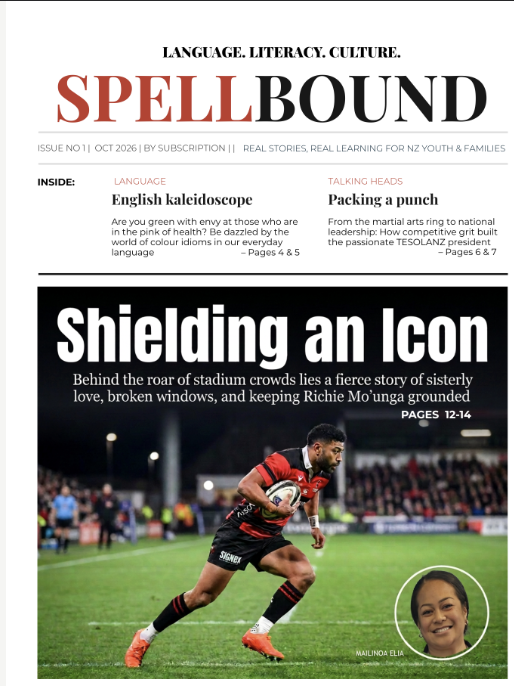
To support New Zealand language educators through the current curriculum shifts, Navjot has gifted the full SPELLBOUND Issue 1 Tabloid and two sample resource kits completely free to the community.
- File 1-SPELLBOUND School Funding and Advocacy Kit SPELLBOUND School Funding & Advocacy Kit (PDF)
(Includes Spellbound’s master teacher appeal, pricing grid, and a copy-and-paste curriculum-aligned Principal Pitch Email Template to help you clear school funds) - SB-Issue 1-Page 1-20-MASTER-ALL PAGES-FINAL-compressed SPELLBOUND Issue 1 Student Tabloid (PDF)
(The complete, high-interest digital New Zealand student newspaper, gifted 100% free to the community) - ISSUE 1 TEACHERGUIDE-SAMPLE P1-IDIOMS-FOUNDATION Sample Teacher Resource Kit - Foundation Pass (PDF)
(Sample explicit structured literacy teaching framework for Stages 1–2) -
ISSUE 1 TEACHERGUIDE-SAMPLE P2-IDIOMS-STEPUP Sample Teacher Resource Kit - Step-Up Pass (PDF)
(Sample explicit structured literacy teaching framework for Stages 3–5)
SB-Issue 1-Page 2-MASTER The vision of SPELLBOUND, and a word from the editor.
If your department or school leadership wishes to unlock the remaining 8 comprehensive Teacher Resource Kits for Issue 1 alongside all upcoming issues for the academic year, please follow these steps:
-
Open the School Funding & Advocacy Kit PDF (see attached), copy the pre-written Principal Pitch Template, and email it straight to your principal or deputy principal.
- Head to www.spellboundmedia.co.nz and complete the quick institutional registration form.
- Your school's Accounts Payable team will automatically receive an official tax invoice containing direct New Zealand bank account details for a standard bank transfer.
-
Upon payment processing, your campus will instantly receive your unique master secure password to unlock the full online Subscriber Vault download repository.
Podcast 14
October 16, 2026
Podcast 13
October 7, 2026
In this podcast, Elisapeci Samanunu Waqanivala shares her personal narrative of migration to Aotearoa; including her journey into tertiary studies. She explains her work as an Oral Historian and her insights she has gained about Vosa vakaViti. This has resulted in her numerous initiatives supporting Fijian language and culture in New Zealand; including the Fijian Language Academy and developing a trilingual podcasts. Finally, she gives educators some advice on supporting Fijian students in educational settings.
Podcast 12
September 22, 2026
Podcast 11
September 18, 2026
Podcast 10
August 29, 2026
Podcast 9
August 27, 2026
Sustaining Community Languages: The Fiji Hindi / Fiji Baat journey
Fiji Hindi is neither a Pidgin nor a Creole. For example, unlike Mauritius—where people speak some Creole, some Hindi, some Bhojpuri but have a high level of fluency in English & French—Fiji Hindi evolved in Fiji with a very sound Hindi base, but with some of its own grammatical features. This evolution started in India but developed in Fiji, similar to Sarnami Hindi that developed in Suriname, both Hindis being shaped by their colonial settings.
This podcast features Sunita Narayan ONZM, the current President of the Community Languages Association of New Zealand (CLANZ). In the podcast, Sunita shares how Fiji-Hindi became a language in the Pacific and some of its interesting linguistic features. This is complemented by Sunita's experiences of supporting the Hindi language through the Wellington Hindi School and the connections made with primary and secondary schools. Finally, Sunita updates us on CLANZ's exciting current and future work.
Dr Hilary Smith's resource on Ten Tips for Using Your Language at Home can be found here.
The CLANZ FaceBook page is here.
Podcast 8
August 14, 2026
Gwenna met with Navjot McCormack to learn about creating magazines with students. We also talked a little about Spellbound, Nav's new resource she is working on to support teachers.
Podcast 7
June 29, 2026
Gwenna sat down with Caroline Scott from Learning Village to hear more about what is available for our learners.
Podcast 6
May 24, 2026
This podcast is with Mark Dawson-Smith from Wintec in Kirikiriroa | Hamilton. The podcast explores Marks insights on themes such as the international student recovery, AI, and changing student demographics.
Podcast 5
May 20, 2026
NEX TESOLANZ Coordinator (Dr. Angela Bland) chats with TESOLANZ Primary SIG leader, Karen Cebalo.
Podcast 4
May 12, 2026
Notes on funding applications
Podcast 3
April 30, 2026
NEX TESOLANZ Coordinator (Dr. Angela Bland) chats with TESOLANZ Branch Liaison, Julie Luxton, about what is forefront for particularly the secondary school sector. Julie is also a PLD facilitator and a NZQA National Moderator.
Podcast 2
April 24, 2026
An interview with former RTLit, Liz Hansen, about life beyond the public sector, and what is available out there to support our akonga.
Podcast 1
April 17, 2026
An introduction and talking about what to expect from our work.